 GM Console
THE TABLETOP SESSION GUIDE
Make your next night around the table a great one.
A practical guide to in-person D&D and tabletop RPG sessions, from seating and shared screens to clear descriptions, welcoming new players, and a ready-to-adapt adventure at the Copper Inn.
Start reading ↓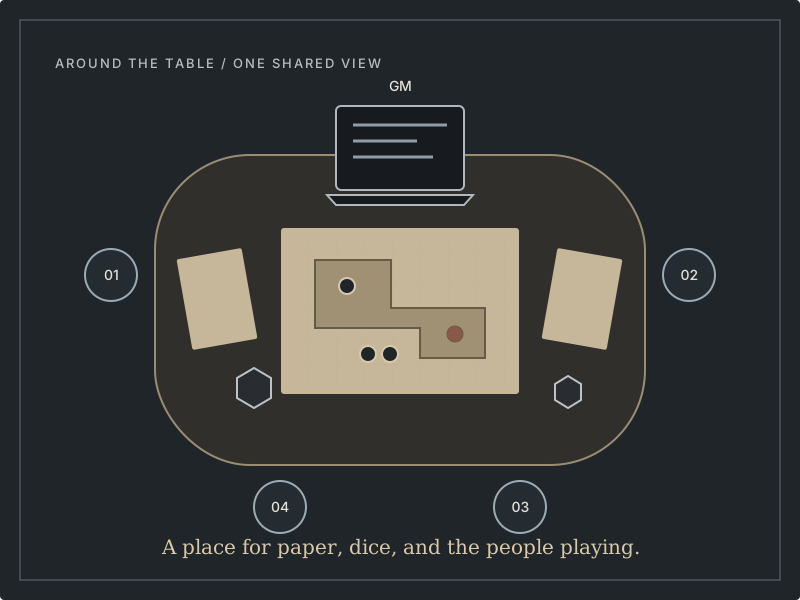
01 / Make the room work
Set up a room people can comfortably play in.
Begin with the people, then arrange the equipment around them. Everyone should be able to see the shared play area, hear the GM, and reach the things they use often. A modest table with clear space can be easier to play at than a crowded setup filled with impressive accessories.
Decide where dice will land and where drinks will sit. A tray or an agreed patch of table helps keep rolls away from miniatures and notes. Put spare pencils, erasers, and a few blank cards in a place anyone can reach. If the GM is the only person who can find basic supplies, small requests will keep interrupting the conversation.
Check the lighting from each seat. A dramatic lamp behind the GM is less useful if a player cannot read their sheet. Keep background music low enough that people can speak normally. Ask the group whether music helps them concentrate, and make it easy to lower or stop it when a scene needs attention.
Leave space for movement. Someone may need to stand, stretch, or step away without climbing past a stack of bags. Ask about practical needs directly instead of assuming everyone is comfortable in the same chair for several hours.
You can add atmosphere later. Start with a room where a person can understand what is happening and make a choice without struggling to see, hear, or reach the table.
02 / Agree on the evening
Give the session a clear shape.
Before the story begins, tell the group when you expect to stop and when you will take a break. A visible end time helps players make decisions about pacing and gives people confidence that the evening will fit their plans. If the schedule changes, discuss it rather than quietly extending the game.
Agree on how phones and other devices fit into play. Some people use a digital character sheet or need to remain reachable. Others find unrelated scrolling distracting. Talk about the behavior you need, such as listening during another player's turn, instead of making assumptions about every screen at the table.
Establish a simple way to pause a scene if someone is confused or uncomfortable. Players should be able to ask for clarification, take a break, or move past a subject without having to justify a personal history. Revisit preferences when a new person joins or the campaign changes tone.
Decide how the group will handle a missing player. Their character might remain offstage, be played only in a limited supporting role, or require the adventure to wait. The best choice depends on your group; consistency matters more than finding one rule for every campaign.
These agreements support the adventure because they reduce uncertainty outside it. When people know the practical shape of the evening, they have more attention available for the fictional problems you actually want them to explore.
03 / Paper and screens
Let paper sheets and personal screens coexist.
An in-person group does not need to use identical tools. One player may have a carefully annotated paper sheet, another may prefer a tablet, and the GM may want a laptop for initiative. Choose a shared routine for the information that overlaps rather than requiring everyone to abandon what they know.
For each resource you track in more than one place, decide which record is authoritative during play. If the GM updates hit points in GM Console while the player also writes them on paper, agree that the new total will be spoken aloud. That gives the player a clear moment to copy the value and raise a question.
Keep personal screens low enough that faces remain visible. A device is useful when it answers a question; it can become a barrier when every conversation happens around its edge. Consider putting a tablet flat or moving the GM's laptop slightly to one side of the play area.
Players who want no screen can be added as guests. The GM can track their seat, initiative, and hit points without giving them an account setup task. Members using the app can follow the same encounter from their own browsers.
Keep detailed character rules in the references your group already uses. GM Console's included character setup does not cover every option, spell, or level. A mixed approach works best when each tool has a clear job and the table knows where to look for the answer.
04 / Names and seats
Make it easy to know who is speaking and acting.
A new group may be learning two sets of names at once: the people at the table and the characters they play. Fold a small card in front of each seat with both names. Add a short role or memorable detail if the player wants one, such as “Mira / Sable, a courier with too many keys.”
Arrange GM Console's seat cards to match the room. Before an encounter, check who is present and which character each member has selected. Going around the same order to collect initiative creates a predictable routine, especially when several people are excited and ready to announce their rolls.
Give guest entries names the GM can recognize quickly. If two characters have similar names, ask the players for a nickname or use a small distinguishing detail. The point is clarity, not forcing anyone to rename a character they care about.
Use equally clear names for opponents. “Dock guard” and “guard on the stairs” are easier to coordinate than three identical entries called Guard. If a participant's position changes, continue using a stable distinguishing feature when possible so the name does not become misleading.
During conversation, address a person by the name that makes the question clear. Ask the player about a rules preference and the character about a decision in the fiction. You do not need a rigid convention, but clear cues help people understand whether they are being invited to act, explain, or simply listen.
05 / A strong opening
Begin with a recap and an immediate situation.
Invite the players to recap before you read your own notes. Ask where the party ended, what they were trying to accomplish, and what they had not yet decided. Their answers show what they remember and which details have become important to them.
Correct misunderstandings gently and distinguish forgotten information from hidden information. If the characters would plainly remember the name of their employer, provide it. You can preserve uncertainty about the employer's motives without making the players guess a fact they learned weeks ago.
Then open with something that calls for a response. A messenger arrives carrying a soaked parcel. The innkeeper asks why the party's horses are already saddled. A crowd has gathered around a well that is making a familiar sound. Give the players enough context to ask a question or take action.
Avoid beginning with a long history lesson unless the group specifically enjoys that style. Introduce background when it explains something they can see or affects a choice they are making. The ruined crest on a doorway is a useful moment to mention the old family that owned the building.
For a new campaign, ask why the characters are already together. A shared job, a mutual friend, or a previous journey can save the first session from becoming a prolonged argument about whether anyone will cooperate. Start with enough connection to act, then let deeper relationships emerge through the adventure.
06 / Describe useful details
Describe places so people can make decisions.
A clear location description tells the players what is immediately noticeable, what seems to matter, and where they might go. Choose a few details with practical consequences. In a crowded workshop, mention the narrow aisle, the open loading door, and the apprentice watching a pot that has begun to smoke.
Add one sensory detail that makes the place memorable. The room might smell of hot copper, the floor might vibrate with machinery, or a bird might repeat the last word of every sentence. A single strong detail often survives in memory better than a paragraph of unrelated colors and furnishings.
Distinguish what is visible from what requires closer investigation. Players should not have to spend a long conversation discovering an obvious exit. On the other hand, a small maker's mark under a table can reward someone who takes time to inspect it.
When a player asks a reasonable question, answer from the character's perspective. If they can see whether a door is locked, tell them. If they cannot know without touching it, explain what they can observe and let them decide whether to investigate.
Use landmarks when the party moves. “Back toward the blue gate” or “past the broken waterwheel” helps the group build a mental map. Repeat the same identifying detail when they return. Familiarity makes the world feel navigable and lets your descriptions become shorter as the players learn their way around.
07 / Maps that serve play
Draw only what the group needs to understand.
A useful map answers a question. Where are the exits? Can the cart fit through this gap? Which route reaches the ridge before nightfall? Start with the information needed for the current decision, then add detail if the group asks for it.
For a small location, a few boxes and connecting lines may be enough. Label the kitchen, courtyard, stairs, and locked store room. Add obstacles that influence movement. You do not need to render every chair before a player can decide how to reach the balcony.
Agree how your table handles distances and positioning under the rules you use. If exact measurements matter to a decision, make the relevant information clear before the player commits. If you are using a more conversational description of space, check that everyone shares the same understanding.
Use tokens with obvious differences. Coins, colored counters, or simple paper markers work when people can identify them consistently. Tell the group what each marker represents and keep the names in the encounter tracker aligned with the table.
Keep a photograph or quick copy of a map if you will resume in the same place. Store it with your own notes, since GM Console does not currently provide a battle-map archive. At the next session, use that image to restore the important positions and remind the party of the situation. The goal is continuity, not making the table look exactly as it did down to the last pencil.
08 / Simple props
Use a prop when it gives players something to do.
A prop works well when it carries information or invites a decision. A short letter can reveal a relationship. A marked delivery slip can point toward a location. A torn map can make the party compare two accounts of the same place. Choose a purpose before spending time on appearance.
Keep written handouts readable. Use clear text, a reasonable size, and enough contrast for the people at the table. You can suggest age with a border or a few marks without making every word difficult to decipher. Offer to read the text aloud so everyone receives the same information.
For a quick adventure handout, write a request in fewer than a hundred words. Include a sender, a specific problem, one useful detail, and a reason time matters. “Bring the iron box to the landing before the bell rings” creates several questions without requiring pages of invented correspondence.
Physical objects can be simple. A plain key with a colored thread, a ribbon from an orchard branch, or a coin with a scratched symbol can become memorable because of what happens around it. Let players decide how to use or investigate the item rather than presenting it only as decoration.
Avoid making a real-world puzzle skill the only route through the story. If the players cannot decode a message, their characters may seek help, gather context, or find another clue. The prop should create play, not stop the evening until someone solves the exact task you imagined.
09 / Share the conversation
Make room for different ways of participating.
At a physical table, enthusiasm can look like interruption. People lean forward, finish each other's ideas, and compete to describe what they do next. A little structure helps keep that energy welcoming instead of leaving quieter players behind.
When several people speak at once, acknowledge the ideas and take them in order. “I heard a plan to inspect the cart and a question for the driver; let's start with the question, then come back to the cart.” Naming both contributions reassures players that their idea has not disappeared.
Invite a quieter participant with a concrete connection to the scene. Ask what their character notices about a familiar craft, how they feel about a proposed bargain, or whether they want to help another person. Give them room to pass. Participation should feel available, not compulsory.
Encourage players to ask each other questions. A character can seek advice, request help, or recall a shared experience. Those exchanges allow the group to build relationships while giving the GM a moment to listen and prepare the next response.
Watch for fatigue as well as shyness. A person who has become quiet may need a break, a recap, or a chance to stand. Ask rather than assuming they are bored or disengaged. The practical work of hosting a game includes noticing the people in the room, not only managing what their characters are doing.
10 / Run clear combat
Make the order visible and the situation understandable.
Before the first initiative roll, describe the scene's immediate problem. The bridge is breaking, the witness is trying to escape, or a group of guards is blocking the only safe exit. Explain where the characters begin and what they can plainly see. Players can choose more confidently when the starting picture is shared.
Collect results around the seats rather than trying to capture every number shouted at once. Confirm the participant and the result as you enter it. In GM Console, that seating flow gives the GM a practical way to include members and guests without losing track of an absent player.
Once the encounter starts, announce who is acting and who is next. Players with their own screen can follow the order, but saying it aloud keeps people using paper sheets equally informed. The next player can prepare an intention while still responding to changes in the scene.
Read a target's name before changing hit points or conditions. If several similar opponents are on the map, point to the token as well. When a value seems wrong, resolve the question while the recent events are still easy to remember.
Keep the fiction present between mechanical updates. Describe the shield splintering, the rope beginning to slip, or the guard glancing toward an escape route. The tracker supports the order and values; your descriptions explain why those details matter. When the danger has been resolved, return to conversation and let the group react to the outcome.
11 / Breaks and resets
Use breaks to give the next scene a fresh start.
A break is useful before people reach the point of frustration. Set an approximate time and stay willing to take one sooner after a difficult scene, a long encounter, or a stretch of intense discussion. A few minutes away can make the second half of the evening feel much more focused.
Before stepping away, state the current situation and the question waiting when play resumes. “You have reached the sealed gate and need to decide whether to wake the caretaker” is enough. Players can return knowing where to place their attention instead of rebuilding the scene through scattered side conversations.
Give yourself a practical reset too. Check the encounter values, put the next location note where you can find it, and write down any improvised names. If a player raised a rules question, decide whether you need to resolve it before continuing or can follow up afterward.
When everyone returns, repeat the situation briefly and ask for the next decision. Avoid reopening every earlier debate unless something has changed. A concise re-entry helps the table feel that the story is moving again.
Near the planned end time, look for a satisfying stopping point. A discovery, a completed journey, or a clear decision can work better than beginning a complicated new encounter. If the group wants to continue, check that everyone can comfortably stay. A campaign benefits from evenings people are happy to return to.
12 / Welcome a new player
Give newcomers a useful first choice.
A new player does not need to learn every rule before making an interesting decision. Begin with their character's immediate situation and ask what they want to achieve. Explain the relevant procedure when it becomes necessary, using the rules your table has agreed to follow.
Offer a few concrete possibilities without turning them into a closed menu. At a damaged bridge, they could inspect the ropes, talk to the stranded traveler, or help secure the cart. Add that another idea is welcome. Examples make the scene approachable while preserving the freedom that makes roleplaying enjoyable.
Pair explanations with action. Show where a resource is recorded when it changes, point out their place in initiative when combat begins, and help them find the rule they need for an ability they actually want to use. A sequence of small explanations is often easier to absorb than one long lecture.
If account setup would slow the evening, add the player as a guest and handle their initiative and hit points from the GM's screen. They can learn the game first and decide later whether a personal app view helps them.
Ask an experienced player to help with finding references, but make sure the newcomer still makes their own decisions. Advice should clarify possibilities rather than take over the character. At the end of the session, ask what was confusing and what they enjoyed. Use those answers to choose the next small piece to explain.
13 / Adventure at the Copper Inn
A ready-to-adapt opening: the storm at the Copper Inn.
For an in-person session with little preparation, begin at an isolated inn during a heavy storm. The party is waiting for the road to reopen when a driver arrives without their wagon. They claim the bridge has failed, but their boots are dry and the innkeeper recognizes the parcel they are carrying.
Put three visible problems in front of the group. Water is entering the cellar, a guest needs medicine from the missing wagon, and someone has locked the stable from inside. These problems can be approached in different orders, and different characters can contribute without needing to know the whole mystery.
Prepare three people with understandable goals. The driver wants to hide that they abandoned valuable cargo to rescue a child. The innkeeper wants to keep travelers inside because the road is unsafe. The person in the stable is a messenger who believes one of the guests intends to steal their orders.
Use a simple map with five areas: common room, kitchen, cellar, courtyard, and stable. Connect them clearly and add two details that can change: rising water and a damaged gate. Players can solve practical problems, question witnesses, and decide whom to trust.
The missing wagon is caught near the bridge with evidence that the bridge was damaged deliberately. The group can end the session by rescuing its passengers or exposing the immediate deception. The larger question remains available for a later adventure: who needed the road closed, and what was supposed to pass through town while nobody could leave?
14 / An evening's outline
Give that adventure a flexible evening outline.
Use an outline to organize your preparation, then adjust it to the group's pace. For the Copper Inn, the opening can be a short round of introductions over supper. Ask each character why they are traveling and one small thing another traveler might notice about them.
Bring in the driver and the immediate problems once everyone has had a chance to speak. Let the party choose whether to question people, secure the building, or investigate outside. Keep a note of what each person is doing so you can move between contributions without forgetting anyone.
Before the break, aim to give the group a discovery that changes their understanding. They might find the rescued child, learn why the stable is locked, or discover that a bridge support was cut before the storm. This creates a clear question for the second half of the session.
After the break, let the players choose a plan. They may organize a rescue, confront a suspect, or split responsibilities between the inn and the road. Use initiative if a dangerous situation needs ordered turns, according to your table's rules. Do not force combat just because you prepared opponents.
Close with the practical outcome and one human response. The patient receives medicine, the innkeeper admits a mistake, or the driver thanks the person who believed them. Ask what the characters intend to do next, and note that answer before ending. It gives your next session a destination chosen by the players.
15 / Connection and fallback
Plan for the ordinary interruptions.
Check the GM's connection before the session and make sure the intended campaign opens. If players will follow live updates, have them sign in and choose their characters before the first busy scene. A short check while people are settling in is easier than troubleshooting during initiative.
GM Console needs an internet connection and does not currently offer offline syncing. If the connection fails, pause updates in the app and write down the current turn, hit points, and changes on paper. Make it clear that the temporary paper record is the one the group is following.
When the connection returns, reconcile those notes before resuming updates on multiple devices. Do not assume changes made during a disruption have been saved or merged automatically. Compare the visible state, correct it deliberately, and tell the group when the shared view is ready again.
Keep a charging cable available if a device will be used for the whole evening. Place it where nobody needs to step over it, and avoid building a setup that depends on several nearly empty batteries. The best arrangement is the one you can keep comfortable and reliable.
Other interruptions deserve the same calm approach. When someone needs to leave briefly, note where the scene stands and agree how to continue. A small practical pause is usually less costly than several people guessing what happened while attention was elsewhere.
16 / Close and continue
End with a record the next session can use.
Leave a few minutes for the end of the evening. Confirm where the party is, what they have just accomplished, and what they expect to do next. If an encounter ended, check any values that carry forward and apply recovery only when the group's rules say it occurs.
Ask each player for one moment they enjoyed or one question they are curious about. Keep the conversation brief and specific. A mention of the nervous messenger or the cut bridge support can tell you which thread deserves attention when you prepare the next adventure.
Write down promises, names, and changes to the world. Did the party agree to escort someone? Did they leave an important object behind? Did a local person become an ally or a rival? These facts are often more valuable next week than a detailed summary of every roll.
Take a picture of a map if positions matter when play resumes, and store it with your own campaign notes. Put physical handouts somewhere they will survive until the next session. Ask who is taking responsibility for shared props or reference sheets so they do not quietly disappear into different bags.
Finally, confirm the next meeting through your group's usual scheduling channel. GM Console can keep the campaign and supported session records together, while your ordinary calendar handles the appointment. A clear closing routine means the next evening begins with anticipation instead of a search for what everyone forgot.
Bring your table together in GM Console.
Campaigns, character resources, initiative, and combat in your browser.