 GM Console
THE GAME MASTER'S FIELD GUIDE
Run a campaign your players want to return to.
A practical guide to preparing and running D&D and other tabletop adventures: build memorable places, give players meaningful choices, and turn one good evening into an ongoing story.
Start reading ↓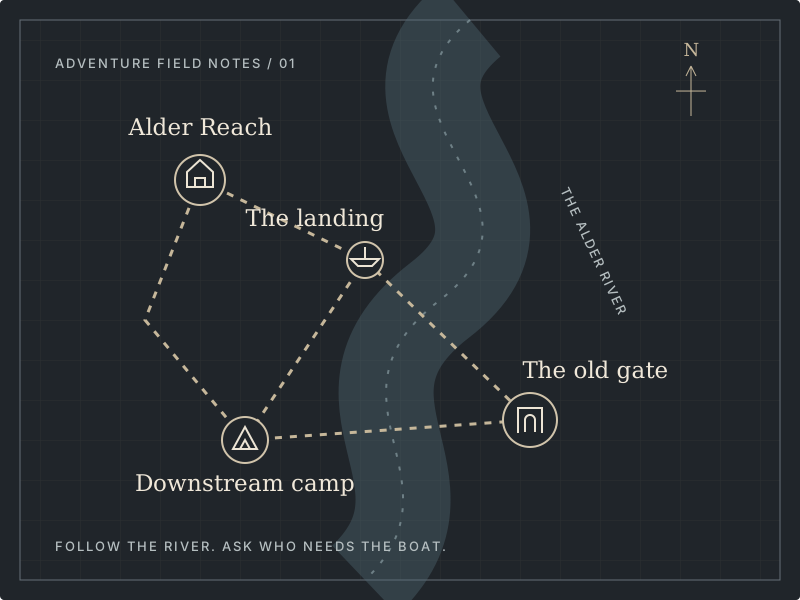
01 / Start with a promise
Start with a promise the players can act on.
A campaign becomes easier to prepare when you can explain its appeal in a few sentences. Tell the players who their characters might be, what they will spend time doing, and what makes this particular world worth exploring. “You are the only people willing to carry messages between towns after the old roads become dangerous” offers a job, a reason to travel, and an immediate source of trouble.
A useful promise is specific enough to inspire characters and flexible enough to survive their decisions. A campaign about protecting a frontier community can include negotiation, expeditions, mysteries, and battles. A campaign that requires the party to accept one patron, follow one route, and spare one villain is much harder to run once people start making choices.
Ask each player which part of the premise interests them. One may want dangerous journeys, another recurring rivals, and another a place to improve between adventures. You do not need to deliver every preference in every session. You do need to know what experiences the group hopes to find.
Write a short version of the promise in your shared campaign description. Keep future revelations in your private notes. The public description should help someone make a character and remember why the party is together. It should be a useful invitation, not a test of whether they have read your world's entire history.
02 / The first conversation
Agree on the kind of game you are making.
Before the first adventure, have a conversation about tone, schedule, and the way people want to participate. A cheerful treasure hunt and a grim survival story can use similar locations while producing very different evenings. Describe the kinds of danger and humor you expect, and invite players to name themes they would rather avoid or keep offstage.
Make that conversation practical. Decide how long a session usually lasts, how breaks work, and what happens when someone cannot attend. Ask whether characters should already know each other and whether conflict within the party is welcome. If a player wants a secret, discuss how it can create interesting scenes without preventing the group from cooperating.
Explain how rules questions will be handled. One possible approach is to look up a rule briefly, make a temporary ruling if the answer is still unclear, and revisit it after the session. Whatever you choose, tell the group in advance so uncertainty does not feel like a surprise change of standards.
Leave room for preferences to change. After a few sessions, ask what has been enjoyable and what has felt awkward. Someone who expected to love political intrigue may discover that they prefer exploration. Another may want more time to speak. Treat that feedback as information for the next session. You are building a recurring activity with real people, and the campaign can become more interesting as you learn how they play.
03 / Prepare situations
Prepare a situation with people who want things.
A situation gives the characters something to investigate or change. Start with a place, a problem, and several people whose goals do not quite fit together. For a river town, the ferry might be missing, the mill owner might need a shipment delivered, and the ferryman's daughter might insist that searching downstream will make everything worse.
Write what each person wants and what they will do if nobody intervenes. The mill owner hires strangers. The daughter hides the spare boat. The town watch closes the landing after dark. These actions create motion without requiring you to know which person the party will trust.
Then add something that complicates the obvious explanation. Perhaps the ferry was deliberately moved to shelter families whose homes are flooding. Recovering it solves the town's transport problem while exposing those families. Suddenly, the adventure offers a choice that conversation can change.
Avoid deciding every scene in advance. Prepare the information available at the mill, the landing, and the downstream camp, then let the party choose where to go. If they invent a sensible fourth approach, use the goals and facts you already established to judge what they find.
This method also helps when the group surprises you. You can ask, “How would the people involved respond?” instead of searching for a way to return to a missing step in your outline. The world remains coherent because its people have reasons to act.
04 / A small starting region
Build a small region with useful connections.
You can begin a campaign with one settlement and three nearby places. Give the settlement a reason people gather there: a river crossing, a seasonal market, a shrine, or a workshop that repairs something nobody else can. Then give each nearby place a connection to that shared center.
For example, the town of Alder Reach depends on an orchard, an abandoned watchtower, and a ferry landing. The orchard supplies winter food. The tower once warned travelers of floods. The landing connects families on opposite banks. A problem in any one location matters to people the characters already know.
Give each destination a visible identity. The orchard has white ribbons on its branches. The tower has a bell hanging outside the broken wall. The landing is lined with boats painted in different family colors. Clear details help players remember places without requiring a map full of labels.
Add routes that create choices. The short road may cross exposed ground, while the longer path passes a useful contact. A flooded trail may be safe on foot but unsuitable for a cart. Explain what the characters can reasonably know before they choose, then let the choice affect the journey.
Expand the region when the party has a reason to look beyond it. A supplier, rival, missing relative, or unusual object can point toward the next town. You will spend more preparation time on places the group is curious about and less on distant locations they may never visit.
05 / Memorable people
Give recurring characters a desire and a tell.
A nonplayer character is easier to portray when you know what they want from the current conversation. The innkeeper wants guests to stop asking about a locked room. The apprentice wants permission to leave town. The watch captain wants a solution that will not embarrass the council. A desire gives you something to respond with when players ask an unexpected question.
Choose one behavior that helps the group recognize the person. They might repair an object while talking, repeat a visitor's name, keep offering food, or become very formal when they are worried. You do not need a special voice. A consistent behavior or rhythm can do the work.
Give helpful people limits. A merchant can provide transport but cannot abandon a sick parent. A scholar knows the old language but will not enter the ruins. Limits encourage the party to make a plan rather than ask one friendly expert to solve everything.
Let relationships change after events. A person whose livelihood the party saved may offer practical help. Someone whose request they ignored may be disappointed without becoming a villain. A rival can respect a clever solution while continuing to pursue a different goal.
Keep a small note after each important conversation: what the person now believes, what they promised, and what the characters promised in return. Those details produce continuity. When the party returns three sessions later and the innkeeper remembers the repaired roof, the place feels like it has continued existing between visits.
06 / Clues that lead somewhere
Make discoveries point toward another decision.
A clue is most useful when it helps players decide what to investigate next. A muddy bootprint can establish that someone passed through a room, but a distinctive red clay that comes from the old quarry also points toward a place. Think about the action each discovery makes possible.
Prepare more than one route to important information. The party might learn about the downstream camp from a witness, a supply receipt, or tracks near the landing. These are separate opportunities to understand the situation. If the group misses one, the adventure can continue through another without the GM repeating the same hint more loudly.
Separate information needed to proceed from optional detail. Knowing that the missing boat traveled downstream may be essential. Learning that its captain once served the watch can enrich a later conversation. A failed attempt to learn the second fact should not leave the group with nowhere to go.
When players draw an unexpected conclusion, ask what evidence they are using. You may discover that your description was unclear or that they noticed a connection you had overlooked. Clarify what their characters can observe before deciding whether the theory is right.
Avoid making every helpful person dishonest. If all information is unreliable, investigation can become exhausting. A straightforward witness with a limited perspective is often more interesting than another elaborate liar. Their account can be accurate while still leaving a larger question unanswered.
07 / Meaningful choices
Show the tradeoff before asking for a decision.
Players can make satisfying choices when they understand what each option might cost. If one road is fast and exposed while another is slow and sheltered, say so. If repairing the gate will use supplies intended for a damaged bridge, make that connection visible. Uncertainty can remain, but the basic tradeoff should be clear.
Try giving the party goals that cannot all be completed in the same way. They might need to protect a witness, keep a public celebration peaceful, and avoid accusing someone without evidence. Different plans favor different priorities. The group's discussion becomes part of the adventure.
Let clever ideas improve the situation. A character who finds another source of timber may save both the gate and the bridge. The tradeoff existed to create a problem worth engaging with, not to guarantee a sacrifice regardless of what the players attempt.
Consequences should follow from the fiction. If the party spends hours helping travelers, the person they were pursuing may gain a lead. If they openly support one faction, another may become cautious. Explain those results through events and reactions rather than announcing that the group chose incorrectly.
Also include decisions that express personality without threatening disaster. Which gift to bring, whose story to believe over supper, or whether to return a borrowed coat can reveal a character. Campaigns need room for small choices as well as the ones that change a town's future.
08 / Encounters with goals
Build encounters around something that can change.
Start encounter preparation by writing a sentence about the goal. The party must get people across the causeway, stop the alarm from being raised, retrieve a stolen box, or persuade the occupants of a ruined shrine to leave. That goal helps you choose participants, terrain, and possible endings.
Give opposing groups a reason to be present. Bandits looking for supplies may retreat once the cargo is inaccessible. Guards protecting a secret may try to delay rather than kill. A desperate person may bargain when they realize the party understands the problem. Motives create options that a list of combat statistics cannot supply by itself.
Choose a few environmental features with clear uses. A gate can be closed, a rope can be cut, and a raised platform can keep someone above floodwater. Describe those features early enough that players can plan around them. If every useful detail appears only after someone guesses the right question, the scene can feel arbitrary.
Before initiative, summarize the starting positions and immediate pressure. Once the order begins, keep names and changes legible. Distinguish similar opponents with visible descriptions such as “red shield” or “near the stairs,” then use those names consistently.
Finish when the encounter's meaningful uncertainty has been resolved. A surrender, escape, successful rescue, or negotiated agreement may provide a better ending than another circuit of turns. Give the party a moment to notice the result and decide what they do with it.
09 / Pacing and spotlight
Move the spotlight with questions, not a stopwatch.
Different people participate in different ways. One player thinks aloud, another waits until they have a complete idea, and another enjoys reacting to friends. Watch for opportunities to invite participation without requiring everyone to perform in exactly the same style.
Use concrete invitations. “Your character knows river boats; what are you looking for at the landing?” is easier to answer than “Do you want to do anything?” It provides a connection to the scene while leaving the player's response open. Give them time to think and permission to pass.
When a conversation has been dominated by two people, summarize the current plan and ask someone else what they want to add. If the party splits briefly, end each short scene on a question or discovery and move to the other group before resolving everything. That leaves people with something to anticipate.
Pacing also depends on contrast. After a tense encounter, allow an ordinary conversation, a quiet description, or a chance to repair equipment. After a long planning discussion, introduce a clear piece of information that helps the group commit. Constant urgency can become as tiring as constant delay.
At the end of the session, ask each player for one moment they remember. Over time, these answers reveal what lands with the group. You can prepare more opportunities for those experiences while still leaving room for surprise, rather than trying to measure enjoyment by who speaks the most.
10 / When plans change
Improvise from what is already true.
When the party takes an unexpected route, pause long enough to identify what you know. Who is nearby? What do they want? What has already happened? Which consequences are moving forward? These facts provide a starting point for an answer that belongs to the same world.
You can say that you need a minute. A short break to sketch a room or consider a response is often less disruptive than inventing a complicated explanation you immediately regret. While you think, ask the players to describe how their characters approach the task. Their intentions may make the next step obvious.
Keep a small reserve of reusable details: a few names, an ordinary workplace, an unusual delivery, a local disagreement, and a person who needs help. Use them when they fit the situation. A prepared person can move to an unplanned roadside stop without forcing the party back toward a particular plot.
Be cautious about changing established facts to preserve a twist. If the players correctly work out what happened, let that knowledge matter. You can still have an exciting session about what they do next. Solving a mystery early is an achievement, not necessarily a preparation failure.
Afterward, write down the details you improvised. A casual promise or invented shopkeeper may become the player's favorite part of the evening. Recording those additions lets the next session honor what happened instead of quietly returning to your original notes.
11 / Adventure: Lantern Ferry
Adventure seed: the ferry that will not come home.
At dusk, the lantern ferry fails to reach Alder Reach. Its bell can be heard downstream, but every boat sent to investigate returns with its lantern extinguished. The village needs the ferry for the next morning's medicine delivery, and the captain's daughter is quietly preventing anyone from taking the last spare skiff.
The truth is practical before it becomes strange. The captain moved the ferry to shelter families trapped by floodwater. They discovered an old river gate beneath the bank, and opening it released a current that carries sound against the flow. The captain cannot move the ferry without leaving the families exposed.
Offer three routes into the situation. A torn supply list points toward the downstream camp. A child saw people loading blankets instead of cargo. The daughter will reveal the rescue if the party promises not to hand the captain over to the angry council. Each route gives information and a relationship to consider.
At the gate, present a choice: close it immediately and strand the ferry, or keep it open while guiding everyone across unstable ground. A local salvage crew wants the gate's metal fittings and may help if offered a fair share elsewhere.
The adventure can end with a rescue, a negotiation, or a risky crossing. Keep the river's strange behavior as a thread for later. Who built a gate that changes the path of sound, and why did the captain recognize the markings?
12 / Adventure: Glass Orchard
Adventure seed: an orchard that remembers promises.
The trees outside a market town bear translucent fruit for the first time in living memory. Anyone who holds a fallen apple hears a promise once spoken beneath its branches. Most are ordinary: a marriage proposal, a child's boast, a deal over grazing rights. One contains a confession that could change who owns the surrounding land.
Begin with a simple job. The orchard keeper wants the fruit gathered before the harvest festival, because visitors are already carrying pieces away. A local family wants a particular tree left untouched. A traveling collector offers more money than the harvest would normally earn.
Prepare several recordings in your notes. One points to a buried boundary marker. Another reveals that someone took blame for an accident. A third is incomplete because a branch broke during the original conversation. The party can investigate the events behind the voices rather than merely accepting every fragment as the whole truth.
The central question is who should hear what the orchard remembers. Public revelation might correct an injustice while exposing unrelated private grief. Selling the fruit solves the keeper's immediate financial problem but removes the evidence from the community.
If you want a physical challenge, a storm threatens to scatter the fragile harvest while competing groups arrive to claim it. The party must decide what to save and whom to trust. Leave one tree silent throughout the adventure. Its roots reach toward an older place, giving the campaign a direction if the players want to keep investigating.
13 / Adventure: The Last Bell
Adventure seed: the bell that rings tomorrow's hour.
A hilltop workshop has produced a bell that rings one hour before an important event in town. It sounded before a warehouse fire, before a lost traveler returned, and before the council discovered a forged order. Now it is ringing continuously, and the bellmaker has vanished.
Give the characters a reason to arrive quickly. A worried apprentice asks for help, a patron wants the bell removed, or a member of the party hears a familiar name in the bellmaker's last written note. The town is dividing between people who trust the warning and people who think it causes the trouble.
The bell predicts a decision, not a fixed disaster. Several groups are preparing to act at the same public gathering: expose a corrupt official, steal a disputed artifact, and evacuate families from an unsafe district. Each plan could prevent harm or create new danger depending on how it unfolds.
Let the investigation reveal those plans through ordinary evidence. Deliveries arrive at unusual hours. A hall is cleared without explanation. The apprentice has been repairing a mechanism far too large for the workshop. The mystery remains playable even if the characters never understand exactly how the magic works.
The bellmaker is hiding because they believe stopping the gathering will cause a worse outcome later. They are frightened and may be wrong. Give the party enough information to choose their own intervention. The ending should reflect their decisions, with the bell finally falling silent when tomorrow becomes something nobody had prepared for.
14 / Connect the adventures
Let consequences connect separate adventures.
A campaign does not need a single hidden villain behind every problem. Connections can grow from the party's relationships and the consequences of earlier decisions. A captain rescued at the ferry might carry supplies for the orchard keeper. A disputed boundary marker might bear the same workshop emblem found in the bellmaker's notes.
Use connections sparingly enough that the world still feels larger than one conspiracy. Some problems are local, some people are simply helpful, and some unusual objects are unrelated. A connection becomes more satisfying when it explains something the players already noticed rather than making every stranger part of the same secret organization.
After each adventure, choose one visible change. The ferry now runs a relief route. The orchard has a public gathering place. The apprentice becomes responsible for the workshop. Mention that change when the party passes through again. It gives the group evidence that their actions have a lasting effect.
Keep one unresolved question from each story, but do not require the party to pursue all of them. Ask what interests them before preparing the next session. A question they actively choose can become a stronger campaign thread than a dramatic reveal you hoped they would follow.
When a character's personal goal overlaps with one of those threads, invite the player to help define the connection. Their missing mentor might have studied the river gate or delivered materials to the workshop. Agree on the useful starting fact while leaving the outcome for play.
15 / GM Console at the table
Keep the practical workflow small and consistent.
Use GM Console for the parts of the session it currently supports: campaign membership, selected characters, guest seats, initiative, hit points, conditions, and shared updates. Keep adventure notes, maps, clues, and the story ideas in this guide in your own planning materials. These adventure-writing suggestions are not a claim that the app generates or stores a complete adventure for you.
Before play, open the right campaign and check the roster. Add anyone joining without an account as a guest. Arrange seats to match the room and mark attendance. If players use personal screens, have them confirm their selected characters and current resources before the first encounter begins.
When initiative is needed, collect results in that order. Use recognizable names for opponents and read a target's name aloud before changing a value. Connected players can follow the current turn while the GM manages the encounter. The group still resolves dice rolls, rules questions, and the effects of conditions.
At the end of a fight, check values that carry into the next scene. Character and guest hit points can persist, so apply any recovery only when your table's rules call for it. The included character setup is a level-one foundation rather than a complete rules engine or advancement system.
This routine should become familiar enough to fade into the background. The benefit is having the next useful fact ready when someone asks for it, leaving more attention for what the characters choose to do.
16 / Prepare your next session
Leave yourself a useful page for next week.
Finish preparation with a short page you can actually use while people are talking. Put the opening situation at the top, followed by the people involved, a few places, the information available, and the likely consequences if nobody intervenes. Keep statistics and rules references wherever your table normally finds them.
Write one vivid opening detail. Rain might be dripping through the council hall roof, every boat at the landing might face the wrong direction, or the baker might be giving away bread because nobody will approach the market square. A concrete image gives the group something to respond to immediately.
Prepare at least two ways the situation could change during the session. A witness leaves, a deadline approaches, or someone makes an offer. These events can move the scene forward when the group needs new information. They should respond to the world and elapsed time rather than punish players for discussing a difficult decision.
Then stop preparing long enough to imagine the players arriving. What do they need to know? What can they choose first? Which character has a natural connection to the problem? If those answers are clear, you probably have enough to begin.
After the game, spend a few minutes recording what actually happened. Keep the names, promises, discoveries, and next destination. Your future self needs an accurate record of the table's adventure more than a polished account of the adventure you expected them to have.
Give the practical details a shared home.
Campaigns, character resources, initiative, and combat in your browser.